
Japanese Sweet Potato Creme Brulee Recipe tastes like silky custard, caramelized sugar, and roasted chestnut had a cozy little dessert baby. It suits anyone who loves classic creme brulee but wants a deeper, nutty sweetness in about 1 hour total, including chill time if you work efficiently. I tested this on a rainy Sunday in my tiny kitchen while my dog judged my torch skills from the doorway.
Why Make This Japanese Sweet Potato Creme Brulee Recipe at Home
Japanese sweet potato creme brulee brings a richer flavor than regular creme brulee, with notes of caramel, roasted nuts, and vanilla. You get a custard that feels luxurious but still light enough to eat after dinner without regretting your life choices.
You also control the sweetness, the texture, and the size of each serving. Plus, you can use leftover roasted Japanese sweet potatoes and turn them into a dessert that looks restaurant-level without restaurant stress.
“This Japanese Sweet Potato Creme Brulee Recipe tastes like fall in a ramekin and impresses everyone at the table without any fancy training. ★★★★★”
Ingredients You Need
Main Ingredients
-
Japanese sweet potatoes (about 2 medium, 14–16 oz total)
- Use Satsumaimo with purple-red skin and pale yellow flesh.
- They taste sweeter and drier than orange sweet potatoes, which gives the custard a thicker, creamier texture.
- If you only find orange sweet potatoes, reduce the sugar slightly and expect a softer custard.
-
Heavy cream 2 cups (480 ml)
- Use at least 36% fat.
- I like Organic Valley or local cream with minimal additives.
-
Whole milk 1/2 cup (120 ml)
- This lightens the custard so it does not feel too heavy.
- You can swap with half-and-half and reduce the heavy cream by 1/4 cup.
-
Egg yolks 6 large
- Use fresh eggs with rich yolks for better color and flavor.
- Save the whites for meringues or omelets.
-
Granulated sugar 1/2 cup (100 g) for the custard
- You can use organic cane sugar, but it may darken the color slightly.
- If your sweet potatoes taste very sweet, drop the sugar to 1/3 cup.
-
Brown sugar or granulated sugar 1/4–1/3 cup for the topping
- Granulated sugar gives a thinner, glassy top.
- Brown sugar gives a thicker, slightly chewier caramel top with deeper flavor.
- I often mix half and half.
-
Vanilla extract 2 teaspoons
- Use pure vanilla extract, not imitation.
- You can also scrape 1 vanilla bean and steep it in the cream for extra flavor.
-
Fine sea salt 1/4 teaspoon
- Salt sharpens the sweetness and brings out the roasted flavor of the Japanese sweet potato.
Optional Flavor Boosters
-
Miso paste (white or shiro miso) 1/2 teaspoon
- This sounds wild, but it adds a subtle savory depth that pairs with caramelized sugar.
- Whisk it into the warm cream until smooth.
-
Cinnamon 1/4 teaspoon
- Adds a cozy note that works well in fall and winter.
- Use lightly so it does not overpower the sweet potato.
-
Yuzu zest or lemon zest 1/2 teaspoon
- Adds brightness and cuts through the richness.
- Zest directly into the custard base.
Pantry Shortcuts
-
Canned Japanese sweet potato puree
- If you find pure Japanese sweet potato puree with no added sugar, you can use 1 cup instead of roasting fresh potatoes.
- Warm it slightly and whisk until smooth before adding to the custard.
-
Pre-made caramel sugar mix
- Some stores sell sugar blends for creme brulee.
- Those work fine, but regular granulated sugar still gives a great crackly top.
Equipment List
-
6–8 ramekins (4–6 ounce size)
- Shallow, wider ramekins give more caramel surface.
- Deeper ramekins give a thicker custard layer.
-
1 large baking dish or roasting pan
- It needs to hold all the ramekins with space for water around them.
-
Kitchen torch
- This gives the best caramel top.
- If you do not own one, you can use the oven broiler, but watch closely.
-
Fine mesh strainer
- This keeps the custard silky by catching any cooked egg bits or sweet potato fibers.
-
Blender or immersion blender
- This smooths the sweet potato custard so it tastes velvety.
-
Kettle or pot for hot water
- You need hot water for the water bath.
-
Whisk, mixing bowls, measuring cups, and spoons
Tips & Mistakes
- Roast Japanese sweet potatoes until very tender and caramelized at the edges for deeper flavor.
- Avoid boiling the sweet potatoes because extra water makes the custard watery and less silky.
- Blend the custard until completely smooth so no fibers or lumps ruin the texture.
- Strain the custard through a fine mesh sieve into a pitcher or bowl with a spout for easy pouring.
- Temper the egg yolks by slowly whisking in warm cream so the eggs do not scramble.
- Do not let the cream boil, since boiling can curdle the mixture and change the texture.
- Skim off foam on top of the custard before baking to keep the surface smooth.
- Place a towel at the bottom of the baking dish so ramekins do not slide when you pour hot water.
- Pour hot water into the baking dish after you place it on the oven rack to avoid spills.
- Bake until the edges set but the centers still jiggle slightly when you nudge the ramekin.
- Do not overbake, because overbaked custard turns grainy and loses its silky feel.
- Chill the custards at least 3 hours so they firm up before you torch the sugar.
- Pat the tops dry with a paper towel before adding sugar so moisture does not melt the sugar prematurely.
- Use a thin, even layer of sugar on top so it caramelizes quickly without burning.
- Move the torch in small circles and keep it in motion to avoid scorching one spot.
- Let the caramelized tops cool 5–10 minutes so the sugar hardens and gives that classic crack.
- Add citrus zest or miso in small amounts and taste as you go so you keep the sweet potato flavor front and center.
- Serve the custards the same day you torch the sugar so the top stays crisp.
- Store custards without the sugar topping if you plan to keep them longer than a day.
- Use shallow ramekins for quicker baking and a more even set.
How to Make Japanese Sweet Potato Creme Brulee Recipe
Step 1: Roast the Japanese Sweet Potatoes
- Preheat your oven to 400°F (200°C).
- Scrub the Japanese sweet potatoes and dry them well.
- Pierce each potato a few times with a fork so steam can escape.
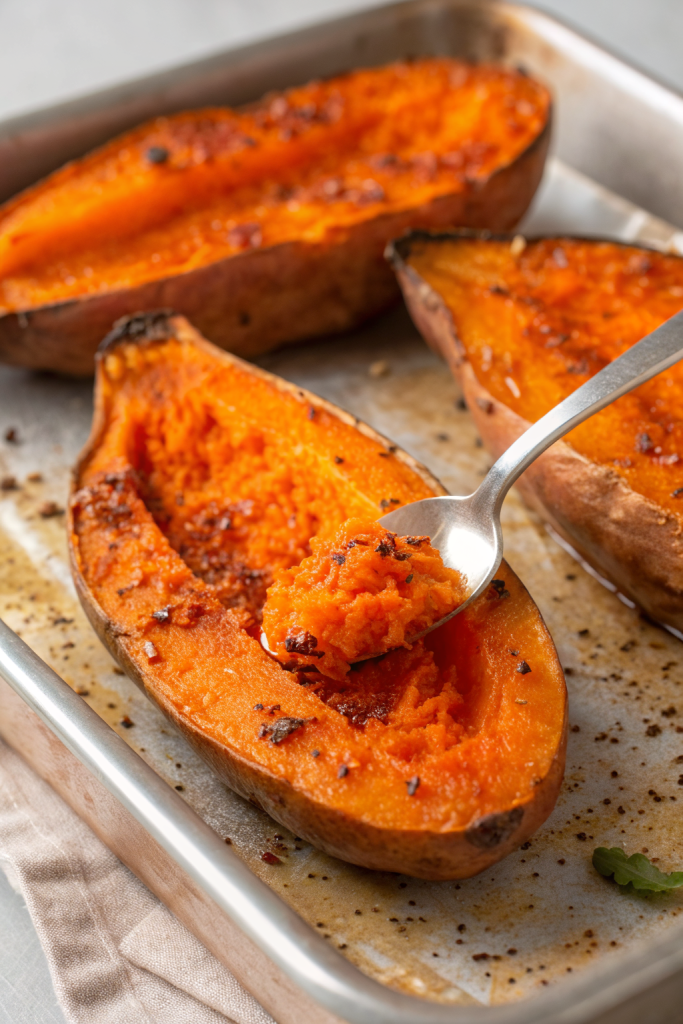
- Place them on a baking sheet and roast for 45–60 minutes, until a knife slides in easily and the juices caramelize around the edges.
- Let them cool until you can handle them comfortably.
Step 2: Prepare the Sweet Potato Puree
- Peel the roasted Japanese sweet potatoes and discard the skins.
- Weigh or measure about 1 cup tightly packed flesh.
- Place the flesh in a bowl and mash until smooth, or use a blender or food processor.
- If the puree looks very thick and dry, loosen it with 1–2 tablespoons of warm cream from the recipe amount.
Step 3: Heat the Cream Mixture
- In a medium saucepan, add 2 cups heavy cream and 1/2 cup whole milk.
- Add the sweet potato puree, 1/2 cup sugar, vanilla, and salt.
- If you use miso, cinnamon, or zest, add them now.
- Whisk over medium-low heat until the mixture steams and small bubbles appear at the edges, about 5–7 minutes.
- Do not let it boil.
- Remove from heat and let it sit for 5 minutes.
Step 4: Blend and Strain
- Blend the warm sweet potato cream mixture with an immersion blender or in a regular blender until completely smooth.
- In a large bowl, whisk 6 egg yolks until they look slightly thick and lighter in color.
- Slowly pour about 1 cup of the warm sweet potato cream into the yolks while you whisk constantly.
- Continue to whisk and add the rest of the cream mixture in a slow, steady stream.
- Set a fine mesh strainer over a large measuring cup or bowl with a spout and pour the custard through the strainer.
Step 5: Prepare the Water Bath
- Preheat the oven to 275°F (135°C).
- Arrange the ramekins in a large baking dish or roasting pan.
- Give the custard a gentle stir to pop any big bubbles, then divide it evenly among the ramekins.
- Skim off any foam from the tops with a spoon.
- Place the baking dish on the middle oven rack.
- Carefully pour hot tap water or recently boiled water into the baking dish until it reaches about halfway up the sides of the ramekins.
Step 6: Bake the Custards
- Bake at 275°F (135°C) for 35–50 minutes, depending on the depth of your ramekins.
- Start checking at 30 minutes.
- Gently tap one ramekin with a spoon.
- The edges should look set, while the center should still jiggle like soft jelly.
- When they reach that stage, remove the baking dish from the oven.
- Use tongs or a towel to lift the ramekins out of the water and place them on a cooling rack.
Step 7: Chill
- Let the custards cool to room temperature, about 30–40 minutes.
- Cover each ramekin with plastic wrap.
- Chill in the refrigerator for at least 3 hours, or up to 2 days, before you caramelize the sugar.
- The custards should feel cold and firm to the touch.
Step 8: Caramelize the Sugar Topping
- When you plan to serve, remove the ramekins from the fridge and pat the tops dry with a paper towel.
- Sprinkle 1–2 teaspoons sugar over each custard in a thin, even layer.
- Light your kitchen torch and hold the flame a few inches above the sugar.
- Move the torch in small circles until the sugar melts, bubbles, and turns deep golden.
- If you use the broiler instead, place the ramekins on a baking sheet, set them under the broiler on high, and watch closely for 3–5 minutes until the sugar caramelizes.
- Let the tops cool for 5–10 minutes so the sugar hardens and forms a crisp shell.
Variations I've Tried
-
Black sesame Japanese sweet potato creme brulee
Stir 1–2 tablespoons black sesame paste into the warm cream mixture.
This version tastes nutty and slightly smoky and pairs beautifully with the caramel top. -
Matcha Japanese sweet potato creme brulee
Whisk 1–2 teaspoons high quality matcha powder into the warm cream before you temper the yolks.
The matcha adds gentle bitterness that balances the sweetness of the Japanese sweet potato. -
Coconut Japanese sweet potato creme brulee
Swap half of the heavy cream with full-fat coconut milk.
The custard turns slightly tropical and still sets nicely if you keep the egg yolk count the same. -
Yuzu or citrus Japanese sweet potato creme brulee
Add 1 teaspoon yuzu juice and 1/2 teaspoon zest to the custard base.
The citrus brightens the dessert and keeps it from feeling too rich. -
Extra caramel version
Sprinkle a very thin layer of sugar, torch it, then add a second thin layer and torch again.
This gives a thicker, shatteringly crisp top that caramel fans love.
How to Serve Japanese Sweet Potato Creme Brulee Recipe
Serve Japanese sweet potato creme brulee slightly chilled with a freshly torched sugar top so the contrast between cool custard and warm caramel feels extra satisfying. I like to add a few fresh berries or thinly sliced strawberries on the side to cut through the richness. A small dollop of unsweetened whipped cream also works nicely, since it softens the sweetness without stealing the show. Pair it with hot green tea, roasted barley tea, or a simple cup of coffee for a cozy finish.
How to store
-
Fridge, un-torched:
Store baked and cooled custards (without sugar topping) covered in the fridge for 2–3 days.
Add sugar and torch just before serving. -
Fridge, torched:
Keep leftover torched creme brulee in the fridge for up to 24 hours.
The custard stays tasty, but the sugar top softens. -
Freezer:
Freeze baked, cooled custards without sugar topping for up to 1 month.
Wrap each ramekin tightly in plastic, then foil, to prevent freezer odors. -
Thawing and reheating:
Thaw frozen custards in the fridge overnight.
Serve them cold, then add sugar and torch right before serving so the top stays crisp.