
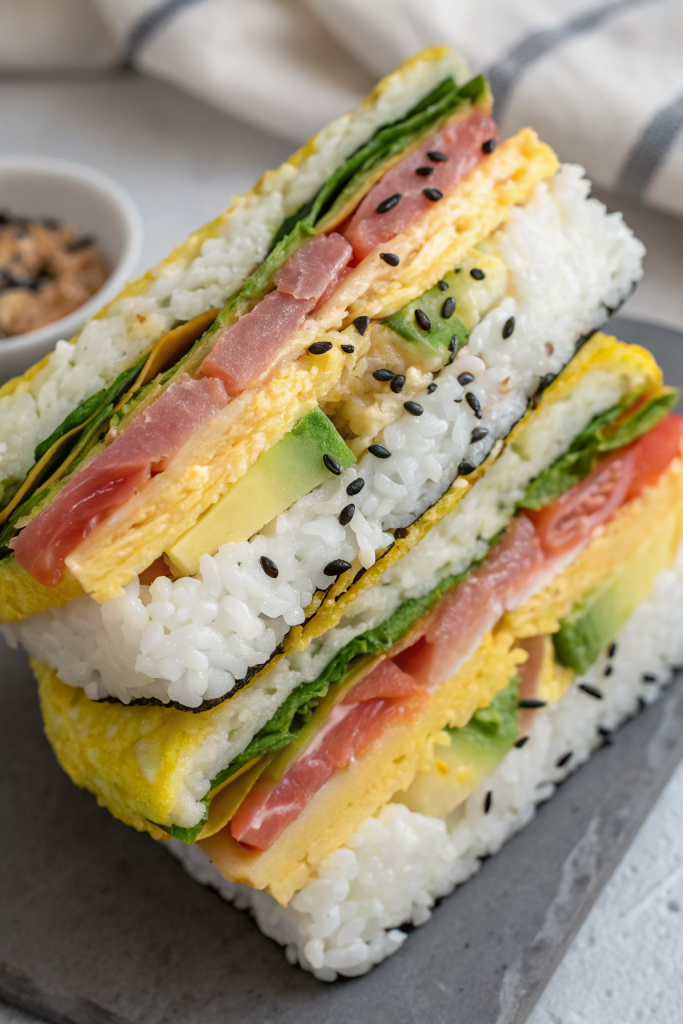
Onigirazu Recipe tastes like the best parts of sushi and a sandwich had a very tidy, seaweed-wrapped baby. It works for busy people who want a portable, customizable meal in about 35 minutes from start to finish. I packed versions of this in my own work lunches for years, and my coworkers always asked what smelled so good.
Why Make This Onigirazu Recipe at Home
Homemade onigirazu costs a fraction of what you pay at a shop, and you control every ingredient. You choose the fillings, adjust the rice, and keep the nori perfectly crisp or pleasantly soft, exactly how you like it.
You also prep a whole week of lunches in one go, which saves money and brainpower. Kids love the handheld square shape, and adults love that it feels like comfort food that still travels well.
“This Onigirazu Recipe became my go-to lunch meal prep, and I look forward to it more than takeout sushi ★★★★★”
Ingredients You Need
Rice and Seasoning
- 2 cups uncooked short-grain Japanese rice
- Use sushi rice or Calrose rice for the best stickiness.
- Avoid long-grain rice, because it stays too loose and falls apart.
- 2 1/4 cups water, for cooking the rice
- 3 tablespoons rice vinegar
- Seasoned rice vinegar works great and saves a step.
- 1 tablespoon sugar
- 1 teaspoon fine sea salt
Nori and Wrapping
- 4 large sheets nori (full-size sushi sheets)
- Choose good-quality, dark, crisp nori; cheap brands taste chewy and fishy.
- Small bowl of water, for sealing corners
- Plastic wrap or parchment squares, slightly larger than the nori sheets
Protein Options
Pick one or mix a couple. Quantities below fill about 4 large onigirazu.
- 1 large chicken breast, cooked and sliced
- I like soy sauce and garlic marinated chicken from leftovers.
- Or 1 can tuna (5 to 6 ounces), drained and mixed with
- 2 to 3 tablespoons Japanese mayo (Kewpie tastes amazing here)
- 1 teaspoon soy sauce
- Or 4 slices thick-cut spam, pan-fried until golden
- Or 4 to 6 strips crispy bacon
- Or 1 block firm tofu, pressed and pan-fried with soy sauce and a little mirin
Veggies and Extras
Mix and match to taste.
- 1 large carrot, cut into thin matchsticks
- 1 small cucumber, seeded and sliced into thin strips
- 1 avocado, sliced
- 4 leaves lettuce or a handful of shredded cabbage
- 2 eggs, cooked into thin omelets and sliced
- 2 tablespoons Japanese mayo
- 1 to 2 tablespoons soy sauce
- 1 teaspoon toasted sesame oil
- Toasted sesame seeds, to taste
- Optional: kimchi, pickled radish (takuan), or pickled ginger for extra punch
Equipment
- Rice cooker or medium saucepan with lid
- Sharp knife
- Cutting board
- Small bowl for seasoning rice
- Plastic wrap or parchment
- Nonstick skillet (for spam, chicken, tofu, or eggs)
- Rice paddle or spatula
Tips & Mistakes
- Rinse rice until the water runs almost clear so the grains cook fluffy and not gummy.
- Season rice while it stays warm so it absorbs the vinegar mixture evenly.
- Let rice cool to just warm before assembling so it does not steam the nori into mush.
- Use slightly damp hands when handling rice so it does not glue itself to your fingers.
- Do not overfill; keep fillings in a neat mound so the square closes cleanly.
- Place rice directly on the nori corners, not the center, so folding stays easy.
- Keep sharp edges of veggies or spam slices toward the middle so they do not poke through the nori.
- Wrap each onigirazu tightly in plastic wrap so it holds its shape while resting.
- Let the wrapped squares sit 10 to 15 minutes before cutting so the rice firms up.
- Use a very sharp, slightly damp knife and slice in one clean motion to avoid tearing.
- Pack them with the cut side up in a container so they do not squash each other.
- If you use avocado, add it toward the center and eat those portions sooner to avoid browning.
How to Make Onigirazu Recipe
Step 1: Cook and Season the Rice
- Rinse the rice in a bowl with cold water, swishing with your hand, then drain. Repeat until the water looks mostly clear.
- Cook the rice in a rice cooker or saucepan with 2 1/4 cups water. Use the white rice setting or bring to a boil, cover, lower heat, and simmer about 15 minutes, then rest 10 minutes off heat.
- Mix rice vinegar, sugar, and salt in a small bowl until the sugar dissolves.
- Transfer hot rice to a wide bowl, drizzle the vinegar mixture over, and fold gently with a rice paddle until the grains look glossy. Spread slightly and let the rice cool to warm.
Step 2: Prep Fillings
- While the rice cooks, slice chicken, spam, tofu, or other protein into strips that fit across the nori.
- Cook spam or tofu in a nonstick skillet until golden on both sides, then drizzle with a little soy sauce.
- Whisk eggs with a pinch of salt, cook into a thin omelet, then slice into strips.
- Cut carrot and cucumber into thin matchsticks, slice avocado, and wash and dry lettuce or cabbage.
- Stir canned tuna with Japanese mayo and soy sauce until creamy.
Step 3: Set Up the Wrapping Station
- Lay a square of plastic wrap or parchment on your work surface.
- Place one nori sheet on top, shiny side down, with a corner pointing up so it looks like a diamond.
- Keep a small bowl of water nearby for your fingers and for sealing the nori corners.
- Fluff the rice gently again so it stays easy to scoop.
Step 4: Build the Rice and Filling Layers
- Scoop about 1/3 to 1/2 cup warm rice into the center of the nori, then shape it into a small square that sits diagonally, with corners pointing to the sides of the nori.
- Add your protein on top of the rice square: strips of chicken, spam, tofu, tuna mixture, or bacon.
- Layer veggies over the protein: carrot, cucumber, lettuce or cabbage, avocado, and any pickles.
- Drizzle a little Japanese mayo, soy sauce, and sesame oil if you like, then sprinkle sesame seeds.
- Top with another 1/3 cup rice, gently pressing it into a square that covers the fillings.
Step 5: Fold and Wrap
- Fold the bottom corner of the nori up over the rice stack, keeping it snug.
- Fold the right corner over, then the left corner, pulling gently so the package feels tight.
- Fold the top corner down to close the square, then wet your finger and dab any spots that need help sticking.
- Use the plastic wrap underneath to wrap the whole square tightly, pressing lightly to compact it.
- Repeat with the remaining nori sheets, rice, and fillings.
Step 6: Rest and Slice
- Let the wrapped onigirazu sit at room temperature for 10 to 15 minutes so the rice sets.
- Use a sharp knife and run it under warm water, then wipe it dry.
- Slice each square in half straight down the middle, cutting through the plastic wrap if you plan to pack them.
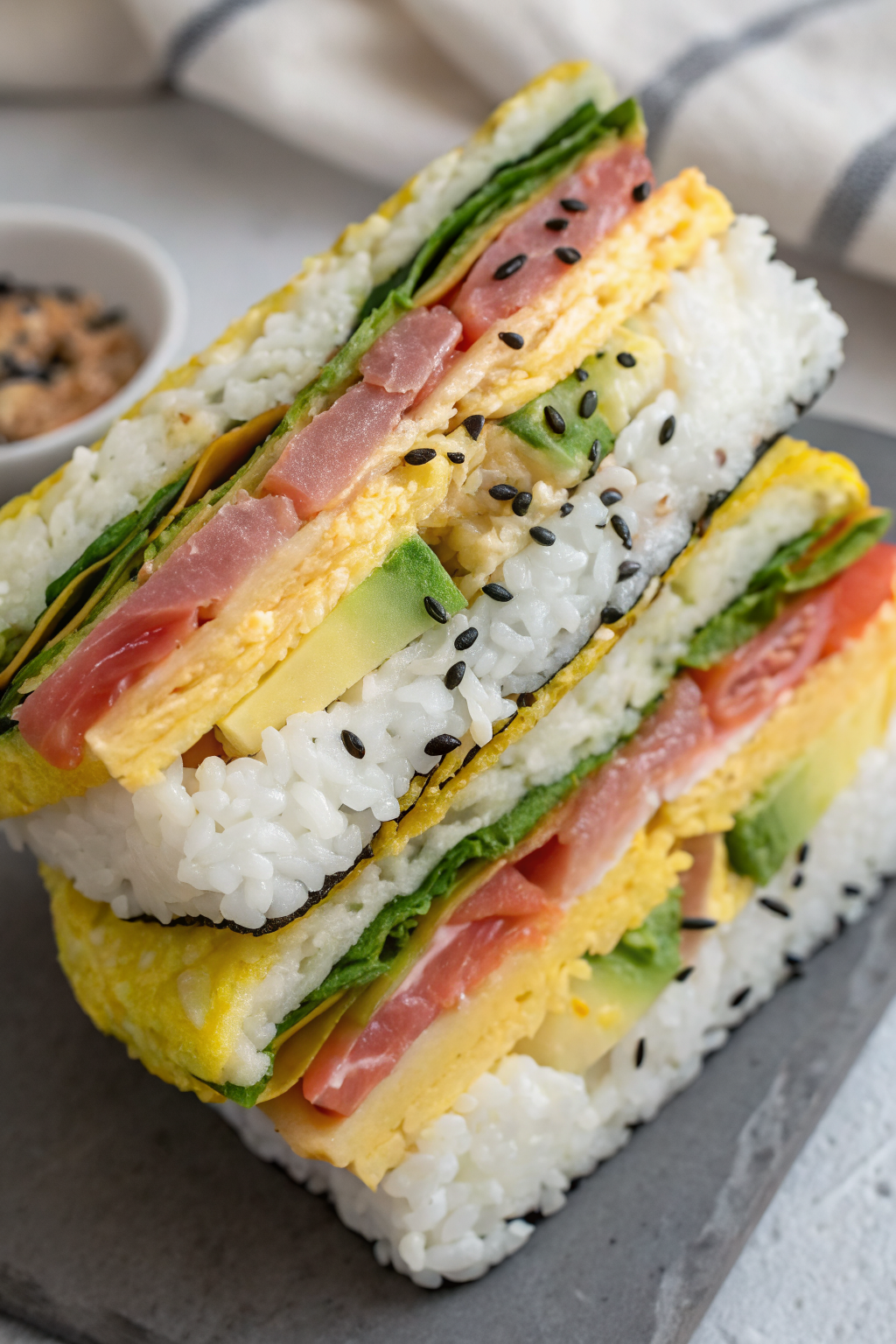
- If you serve them right away, unwrap and place cut side up so everyone sees the pretty layers.
Variations I've Tried
- Spicy tuna onigirazu: Mix canned tuna with Japanese mayo, soy sauce, and a squeeze of sriracha, then add cucumber and avocado. This tastes like a sushi roll in sandwich form.
- Spam and egg breakfast onigirazu: Use pan-fried spam, egg omelet strips, and lettuce, with a little ketchup or mayo. Kids inhale this version.
- Teriyaki chicken onigirazu: Toss leftover chicken in teriyaki sauce, then add shredded cabbage and sesame seeds. This works perfectly for using up dinner leftovers.
- Tofu and veggie onigirazu: Pan-fry firm tofu with soy sauce and a touch of maple syrup, then add carrot, cucumber, lettuce, and avocado. This one tastes light but still fills you up.
- Kimchi cheese onigirazu: Layer spam or bacon, chopped kimchi, and a slice of melty cheese. The combo tastes salty, tangy, and a little wild in the best way.
How to Serve Onigirazu Recipe
Serve onigirazu at room temperature for the best texture, since cold rice turns a bit firm. Pack them in lunch boxes with sliced fruit, edamame, or a simple green salad. Add a small container of soy sauce or a mix of soy sauce and a little sesame oil for dipping. Kids also love them with miso soup or a thermos of simple broth on the side.
How to store
- Room temperature: Keep onigirazu at cool room temperature for up to 4 hours if you use low-risk fillings like cooked meat, tofu, or veggies.
- Fridge: Store wrapped tightly in plastic wrap, then in an airtight container, for up to 2 days. The rice firms up, so let it sit at room temperature 20 to 30 minutes before eating.
- Freezer: Wrap each piece in plastic, then place in a freezer bag and freeze up to 1 month. Avoid raw veggies with high water content if you freeze, since they turn soggy.
- Reheating: If you want them warm, keep the plastic off, wrap in a slightly damp paper towel, and microwave in short bursts of 20 to 30 seconds until just warm. Let them rest a minute so the heat spreads evenly.
Onigirazu Recipe
Ingredients
Instructions
- Season the warm cooked rice with salt and rice vinegar if using, gently folding to combine. Set aside.
- Beat the eggs with 1 teaspoon of soy sauce. Heat the vegetable oil in a small pan over medium heat and cook the eggs into a flat omelet. Once set, remove and slice into 2 portions.
- Place a sheet of plastic wrap on the work surface. Lay one nori sheet on top, shiny side down, with a corner pointing toward you (diamond shape).
- Spoon about 1/2 cup of rice into the center of the nori and shape it into a compact square.
- Layer one lettuce leaf over the rice, then add a portion of omelet, 2 slices of ham or turkey, cucumber and carrot sticks, and 1 tablespoon of Japanese mayonnaise. Drizzle with 1 teaspoon of soy sauce if desired.
- Top the filling with another 1/2 cup of rice, gently pressing to form a neat square that covers the filling.
- Fold the corners of the nori over the rice square, one by one, to enclose the filling and form a compact parcel. Use the plastic wrap to help tighten the shape.
- Repeat with the remaining nori, rice, and fillings to make a second onigirazu.
- Let the wrapped onigirazu rest for 5 minutes to allow the nori to soften slightly, then unwrap and slice each in half with a sharp, damp knife.
- Serve immediately or wrap tightly for a portable lunch.
Notes
Approximate per serving (one onigirazu): 420 calories; fat 15 g; saturated fat 3 g; carbohydrates 55 g; fiber 3 g; sugars 4 g; protein 17 g; sodium 930 mg. Values will vary based on specific brands, fillings, and portion size.
Leave a Reply